Our church history
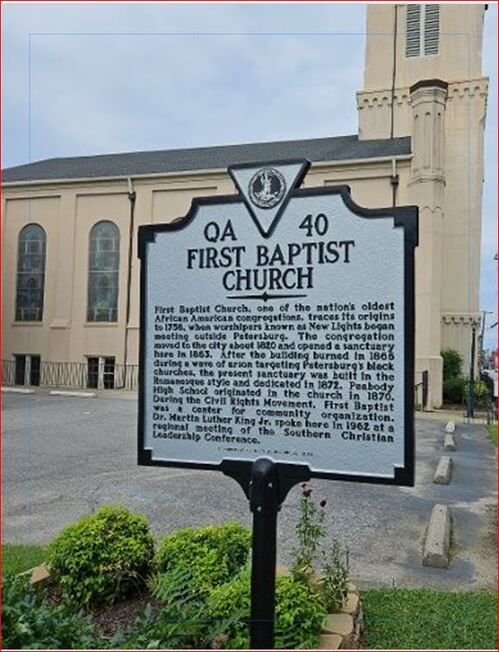
The First Baptist Church had a very humble, yet powerful, beginning in Prince George County when a group of Blacks known as the New Lights gathered for worship. Little did they realize that these gatherings would unfold as the oldest Black church in the Nation. The First Baptist Church has survived turbulent wars, social, and economic events.
In 1756, Elders William Murphy, Phillips and Mackey preached to the scattered members of the New Lights. In 1758 and 1759 arrangements were made to organize the members into a church; however, they remained scattered until 1774 when the Rev. John Michaels united them and formed a regular Baptist Church known as the First African Baptist Church on the estate of Col. William Byrd. The organization moved to Petersburg after the meetinghouse was destroyed by fire. A house of worship was built on Harrison Street, near the present location. Elder John Benn was pastor, and the church became a member of the Portsmouth Association in 1829. This house was also the victim of fire, and the congregation moved to Oak Street where Oaks Warehouse once stood.
After the death of Elder Benn, Elder Daniel Jackson took charge of the congregation. During this time Mr. Robert Bolling, father of Cols. George and Robert Bolling, sold to the church for a nominal sum, the lot on Harrison Street where the old house once stood, facing Maple Lane.
The Daily Express of Petersburg in 1856 carried a news item under ‘’African Baptism’’ indicating that the Rev. Daniel Jackson of the African Church baptized seventeen colored converts in the river above the falls—six males and eleven females. A large crowd of all colors collected on either side of the river to see the immersion.¹
Elder Jackson served as pastor until after Nat Turner’s insurrection (August 21, 1831) when the law was changed to have a white person present at all church meetings. Woodson indicated in The History of The Negro Church, “in 1832 Virginia passed a law to silence Negro preachers, making it impossible for them to function except in compliance with very rigid regulations and in the presence of certain discreet white men.”2
In recording the history of Petersburg, Wyatt and Scott stated that ‘’Petersburg’s population in 1850 was 14,010 including 6,665 white persons, 2,615 free Negroes, and 4,729 slaves.”3
In spite of deplorable economic and social conditions of Blacks, the African Church (First Baptist) had a broad spectrum of Chris-tian witnessing, evidenced by a statement in the Daily Democrat. “Meeting in South Ward –An enthusiastic meeting of the democracy of South Ward was held last evening at the African Church. Entertaining and eloquent speeches were made by Messrs.', Vaughan, Meade, Claiborne, Mason, Watson, and others… The finest feeling prevailed…The spirit of our Democracy is now fully up...’’ 4
Previous recordings of the history of First Baptist stated that in 1842 the church had a great revival and many were baptized into the membership. In 1847, the old house was dedicated. Pastors serving from 1842 through 1858 were Rev. Gwaltney (who also served Gillfield Baptist Church), and Elder R. N. Lee (white), Rev. John Butler (white) took charge in 1858, and in 1860, 600 persons were added to membership.
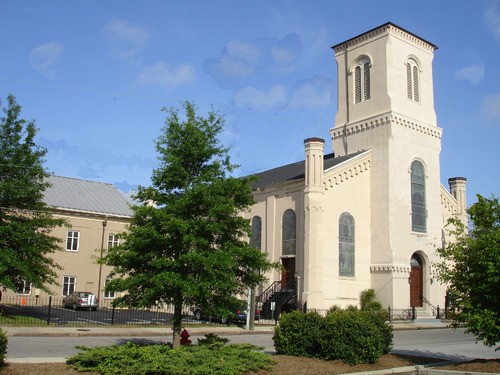
The old church became too small and the lot where the present church stands was secured. A sanctuary was built at a cost of $11,000 and was dedicated in 1863 and Rev. Thomas Hume preached the dedicatory sermon.
Of interest is an item, in part, which appeared in the Daily Ex-press in 1859; “Mr. Kevan offered a petition signed by Daniel Jackson and others, trustees of the African Church, asking for a treaty with the city, for a sufficient portion of the city property opposite the Lawn, to give their present church 100 feet front by 150 feet depth… This church lot was given by Robert Bolling. In 1865, when Rev. Butler left, the church had a membership of 1,700.
Rev. Harrison Scott was then called to the pastorate. Elder John H. Gaines followed him. In 1866, the house was burned, but the leading white citizenry subscribed a sum of $3,000 to rebuild. A contract was made on the 31st day of July 1868 between trustees of First Baptist Church for the sum of seven thousand and six hundred dollars for construction.
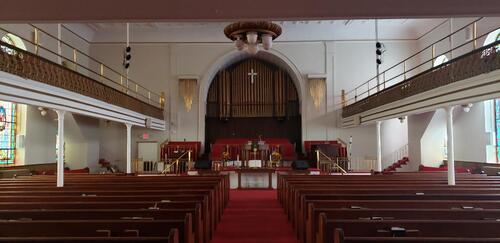
In 1869 the work of building the present house was begun, and by 1870 work had advanced to the point that it was useable for worship. Rev. P.T. Smith was pastor for 18 months.
Rev. Leonard A. Black of New Haven, Connecticut, was called in 1873. He served until his death in April 1883. During his pastor-ate, approximately 1,700 persons joined the church, giving it a total membership of around 3,600. The steeple to the present church was erected, the building and lot where the parsonage once stood (north side of church) were purchased and the out-standing debt on the church building of $14,000 was paid. On the day of his funeral (April 30, 1883), every place of business where a Black person was employed was closed
Rev. Charles B. W. Gordon (native of Bertie County, N.C.) a student of Richmond Theological Seminary was called in January of 1884. “Rev. Gordon accepted the call. A church one hundred and fourteen years old, with upwards of four thousand members.”6 Rev. Gordon served the church until March 1890. At which time, he re-signed and organized the Tabernacle Baptist Church. During his pastorate, First Baptist Church and the parsonage were remodeled at a cost of $14,000, a pool was installed, stained glass windows, pews with doors and cushions, gas-lights and about 800 members were added.
In November of 1890, Dr. E. M. Brawley of Nashville, Tennessee assumed the pastorate and served two years. He promoted unity within the church and accomplished the following: a school where adults were taught to read and write, a library containing religious literature, commentaries, and a director of religious education. This school evolved into the first high school for Blacks in the States of Virginia (later known as the Peabody High School).7
Rev. S. T. Eldridge began his pastoral duties on March 1, 1917. The church was remodeled. Electric lights were installed. A chandelier was purchased at a cost of $500.00. The choir stand was moved downstairs in the lower auditorium of the church. An addition of two rooms was made into a parsonage. The L.A Black Circle and the Missionary Circle were organized. Rev. Eldridge preached his farewell sermon in June of 1923.
After a lapse of six months, Rev. W .E. Sanderlin of Cool Springs Baptist Church, Franklin VA, accepted and took charge on December 30, 1923. Four organizations were formed: The Ladies Usher Board, Willing Workers, Mary M. Clark Memorial Circle, and Thomas H. Ridley Memorial Club. A $5,000.00 pipe organ was installed and a glee club was organized. Church membership was in-creased by 600 and steam heat was installed at a cost of $2,000.00. Due to ill health, Rev. Sanderlin resigned: the church accepted and on Sunday November 14, 1937, he preached his farewell sermon.
After nine months, a call was extended to Rev .W .W. Robert, of East Spencer, N.C. He became pastor on the First Sunday in September 1938. The church renovated the parsonage at a coast of $800.00. Rev. Robert staged $100.00 to retire the debt on the steam heat. A bus was purchased, a cooling system was installed, the church renovated and The Junior Chorus was organized and Rev Roberts served until his death in 1956.
Rev. Milton A. Reid was called in 1957. Several improvements were made to the church; a modern kitchen, additional rest rooms, church library, a new baptistery church lounge, church office pas-tor’s study, and a fellowship room. The old parsonage was remolded and was called the Church Annex. Property at Pine Ave. was purchased and became the church parsonage. The choir stand was enlarged, the pulpit redesigned, the organ was overhauled and a grand piano was purchased. These improvements were in excess of $80,000.
Organizational additions were, Church Council, finance board, social action committee Board of Christian Education, Board of Deaconess, and the Boys and Girl Scout troops. To the church staff were added a church secretary and a secretary to the pastor. The Young Adult Christian Organization and the gentlemen's J. H. Threatt Memorial Club were formed. Rev. Reid served for nine years, and resigned, effective July 31, 1966.
Rev. Clyde Johnson began his service in March of 1968. the indebtedness of over $70,000 was liquidated, additional property was purchased. A new heating system was installed, stained glass windows were replaced, chimes were added to the organ and the Educational Building, and the Bernice Morgan Memorial Chapel was erected. The M.M Clark Fellowship Room was refurbished, other exterior and interior improvements were made.
The Maude E. Taylor Memorial Club and Male Chorus were organized. A broader youth program was added to the church .The Ambassadors (senior citizens) was organized on November 20, 1983. Rev. Johnson resigned effective September 7, 1987.
Rev. Robert Jemerson served as interim pastor for eighteen months (January 1, 1988 through June 30, 1989). This service complemented his daily chaplain duties as an active duty member of the U.S. Air Force. Rev. Jemerson led the church with zeal and spiritual enrichment in his role of interim pastor.
Rev Harold A. Carter Jr., began his ministry at First Baptist on July 30, 1989. Under his leadership, additional ministries and programs were established: Saturday morning Bible Study, Disciples of Christ, Officers in Training, updated clothes closet, a food pantry, radio ministry, major refurbishments of the church sanctuary, M. M. Clark Memorial Room, and purchased a new church bus and van. Rev. Carter resigned in September 1996.
Rev. Dr Gilbert G. Campbell, Sr., Became interim pastor in January 1997, and served faithfully until August 1999. An already established Christian leader, he endeared himself to the full membership .The all-member tithe once a year was successful. New office furniture, equipment and a Harrison Street lot were purchased: bathrooms were renovated, an electric piano purchased, and a new A-frame roof was placed on the education building. First Baptist was spiritually enriched as a result of his splendid service to full membership.
Rev. Dr. Jeremiah Tillman was called as pastor on July 26, 1999. Dr. Tillman, a native of Jackson MS, is a teacher, author, and ex-military chaplain. He came to First Baptist from South Carolina, beginning service on the first Sunday of September 1999.
In 1756, Elders William Murphy, Phillips and Mackey preached to the scattered members of the New Lights. In 1758 and 1759 arrangements were made to organize the members into a church; however, they remained scattered until 1774 when the Rev. John Michaels united them and formed a regular Baptist Church known as the First African Baptist Church on the estate of Col. William Byrd. The organization moved to Petersburg after the meetinghouse was destroyed by fire. A house of worship was built on Harrison Street, near the present location. Elder John Benn was pastor, and the church became a member of the Portsmouth Association in 1829. This house was also the victim of fire, and the congregation moved to Oak Street where Oaks Warehouse once stood.
After the death of Elder Benn, Elder Daniel Jackson took charge of the congregation. During this time Mr. Robert Bolling, father of Cols. George and Robert Bolling, sold to the church for a nominal sum, the lot on Harrison Street where the old house once stood, facing Maple Lane.
The Daily Express of Petersburg in 1856 carried a news item under ‘’African Baptism’’ indicating that the Rev. Daniel Jackson of the African Church baptized seventeen colored converts in the river above the falls—six males and eleven females. A large crowd of all colors collected on either side of the river to see the immersion.¹
Elder Jackson served as pastor until after Nat Turner’s insurrection (August 21, 1831) when the law was changed to have a white person present at all church meetings. Woodson indicated in The History of The Negro Church, “in 1832 Virginia passed a law to silence Negro preachers, making it impossible for them to function except in compliance with very rigid regulations and in the presence of certain discreet white men.”2
In recording the history of Petersburg, Wyatt and Scott stated that ‘’Petersburg’s population in 1850 was 14,010 including 6,665 white persons, 2,615 free Negroes, and 4,729 slaves.”3
In spite of deplorable economic and social conditions of Blacks, the African Church (First Baptist) had a broad spectrum of Chris-tian witnessing, evidenced by a statement in the Daily Democrat. “Meeting in South Ward –An enthusiastic meeting of the democracy of South Ward was held last evening at the African Church. Entertaining and eloquent speeches were made by Messrs.', Vaughan, Meade, Claiborne, Mason, Watson, and others… The finest feeling prevailed…The spirit of our Democracy is now fully up...’’ 4
Previous recordings of the history of First Baptist stated that in 1842 the church had a great revival and many were baptized into the membership. In 1847, the old house was dedicated. Pastors serving from 1842 through 1858 were Rev. Gwaltney (who also served Gillfield Baptist Church), and Elder R. N. Lee (white), Rev. John Butler (white) took charge in 1858, and in 1860, 600 persons were added to membership.
The old church became too small and the lot where the present church stands was secured. A sanctuary was built at a cost of $11,000 and was dedicated in 1863 and Rev. Thomas Hume preached the dedicatory sermon.
Of interest is an item, in part, which appeared in the Daily Ex-press in 1859; “Mr. Kevan offered a petition signed by Daniel Jackson and others, trustees of the African Church, asking for a treaty with the city, for a sufficient portion of the city property opposite the Lawn, to give their present church 100 feet front by 150 feet depth… This church lot was given by Robert Bolling. In 1865, when Rev. Butler left, the church had a membership of 1,700.
Rev. Harrison Scott was then called to the pastorate. Elder John H. Gaines followed him. In 1866, the house was burned, but the leading white citizenry subscribed a sum of $3,000 to rebuild. A contract was made on the 31st day of July 1868 between trustees of First Baptist Church for the sum of seven thousand and six hundred dollars for construction.
In 1869 the work of building the present house was begun, and by 1870 work had advanced to the point that it was useable for worship. Rev. P.T. Smith was pastor for 18 months.
Rev. Leonard A. Black of New Haven, Connecticut, was called in 1873. He served until his death in April 1883. During his pastor-ate, approximately 1,700 persons joined the church, giving it a total membership of around 3,600. The steeple to the present church was erected, the building and lot where the parsonage once stood (north side of church) were purchased and the out-standing debt on the church building of $14,000 was paid. On the day of his funeral (April 30, 1883), every place of business where a Black person was employed was closed
Rev. Charles B. W. Gordon (native of Bertie County, N.C.) a student of Richmond Theological Seminary was called in January of 1884. “Rev. Gordon accepted the call. A church one hundred and fourteen years old, with upwards of four thousand members.”6 Rev. Gordon served the church until March 1890. At which time, he re-signed and organized the Tabernacle Baptist Church. During his pastorate, First Baptist Church and the parsonage were remodeled at a cost of $14,000, a pool was installed, stained glass windows, pews with doors and cushions, gas-lights and about 800 members were added.
In November of 1890, Dr. E. M. Brawley of Nashville, Tennessee assumed the pastorate and served two years. He promoted unity within the church and accomplished the following: a school where adults were taught to read and write, a library containing religious literature, commentaries, and a director of religious education. This school evolved into the first high school for Blacks in the States of Virginia (later known as the Peabody High School).7
Rev. S. T. Eldridge began his pastoral duties on March 1, 1917. The church was remodeled. Electric lights were installed. A chandelier was purchased at a cost of $500.00. The choir stand was moved downstairs in the lower auditorium of the church. An addition of two rooms was made into a parsonage. The L.A Black Circle and the Missionary Circle were organized. Rev. Eldridge preached his farewell sermon in June of 1923.
After a lapse of six months, Rev. W .E. Sanderlin of Cool Springs Baptist Church, Franklin VA, accepted and took charge on December 30, 1923. Four organizations were formed: The Ladies Usher Board, Willing Workers, Mary M. Clark Memorial Circle, and Thomas H. Ridley Memorial Club. A $5,000.00 pipe organ was installed and a glee club was organized. Church membership was in-creased by 600 and steam heat was installed at a cost of $2,000.00. Due to ill health, Rev. Sanderlin resigned: the church accepted and on Sunday November 14, 1937, he preached his farewell sermon.
After nine months, a call was extended to Rev .W .W. Robert, of East Spencer, N.C. He became pastor on the First Sunday in September 1938. The church renovated the parsonage at a coast of $800.00. Rev. Robert staged $100.00 to retire the debt on the steam heat. A bus was purchased, a cooling system was installed, the church renovated and The Junior Chorus was organized and Rev Roberts served until his death in 1956.
Rev. Milton A. Reid was called in 1957. Several improvements were made to the church; a modern kitchen, additional rest rooms, church library, a new baptistery church lounge, church office pas-tor’s study, and a fellowship room. The old parsonage was remolded and was called the Church Annex. Property at Pine Ave. was purchased and became the church parsonage. The choir stand was enlarged, the pulpit redesigned, the organ was overhauled and a grand piano was purchased. These improvements were in excess of $80,000.
Organizational additions were, Church Council, finance board, social action committee Board of Christian Education, Board of Deaconess, and the Boys and Girl Scout troops. To the church staff were added a church secretary and a secretary to the pastor. The Young Adult Christian Organization and the gentlemen's J. H. Threatt Memorial Club were formed. Rev. Reid served for nine years, and resigned, effective July 31, 1966.
Rev. Clyde Johnson began his service in March of 1968. the indebtedness of over $70,000 was liquidated, additional property was purchased. A new heating system was installed, stained glass windows were replaced, chimes were added to the organ and the Educational Building, and the Bernice Morgan Memorial Chapel was erected. The M.M Clark Fellowship Room was refurbished, other exterior and interior improvements were made.
The Maude E. Taylor Memorial Club and Male Chorus were organized. A broader youth program was added to the church .The Ambassadors (senior citizens) was organized on November 20, 1983. Rev. Johnson resigned effective September 7, 1987.
Rev. Robert Jemerson served as interim pastor for eighteen months (January 1, 1988 through June 30, 1989). This service complemented his daily chaplain duties as an active duty member of the U.S. Air Force. Rev. Jemerson led the church with zeal and spiritual enrichment in his role of interim pastor.
Rev Harold A. Carter Jr., began his ministry at First Baptist on July 30, 1989. Under his leadership, additional ministries and programs were established: Saturday morning Bible Study, Disciples of Christ, Officers in Training, updated clothes closet, a food pantry, radio ministry, major refurbishments of the church sanctuary, M. M. Clark Memorial Room, and purchased a new church bus and van. Rev. Carter resigned in September 1996.
Rev. Dr Gilbert G. Campbell, Sr., Became interim pastor in January 1997, and served faithfully until August 1999. An already established Christian leader, he endeared himself to the full membership .The all-member tithe once a year was successful. New office furniture, equipment and a Harrison Street lot were purchased: bathrooms were renovated, an electric piano purchased, and a new A-frame roof was placed on the education building. First Baptist was spiritually enriched as a result of his splendid service to full membership.
Rev. Dr. Jeremiah Tillman was called as pastor on July 26, 1999. Dr. Tillman, a native of Jackson MS, is a teacher, author, and ex-military chaplain. He came to First Baptist from South Carolina, beginning service on the first Sunday of September 1999.
Expanding the vision...
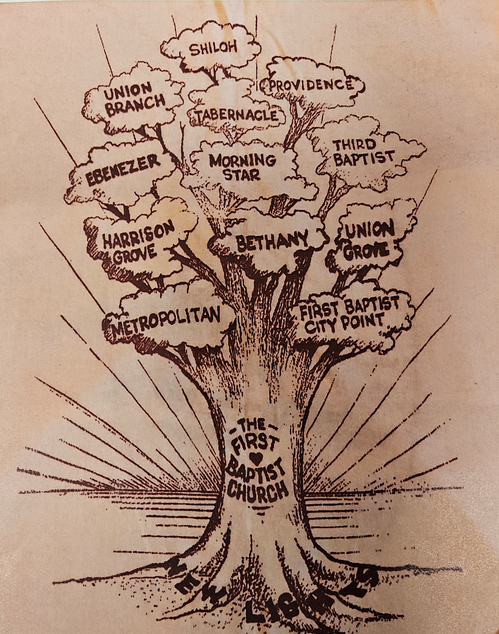
These are the churches that were birthed out of First Baptist Church.
Where we are headed...
The future maybe unknown right now, we hope YOU will be added to our story.